

By Kris Downing, LCSW-S, SEP and clinically reviewed by Teri Schroeder, LCSW
How do we motivate kids to do what matters for their growth, make life easier, and keep our own sanity? For kids with ADHD, the usual pep talks and “just try harder” rarely work. Below are practical ways to increase motivation with ADHD, what to think about before choosing rewards, and a few trusted articles with more ideas.
How to Increase Motivation With ADHD
Kids with ADHD usually want to do well. The ADHD brain just runs on a different kind of fuel. It gets going when something is interesting, new, urgent, or a little bit challenging, and it stalls when a task is boring and the payoff is far away. To a child with ADHD, homework due Friday might as well be due next year. So rather than asking your child to try harder, change the task so it gives their brain what it needs to get started.
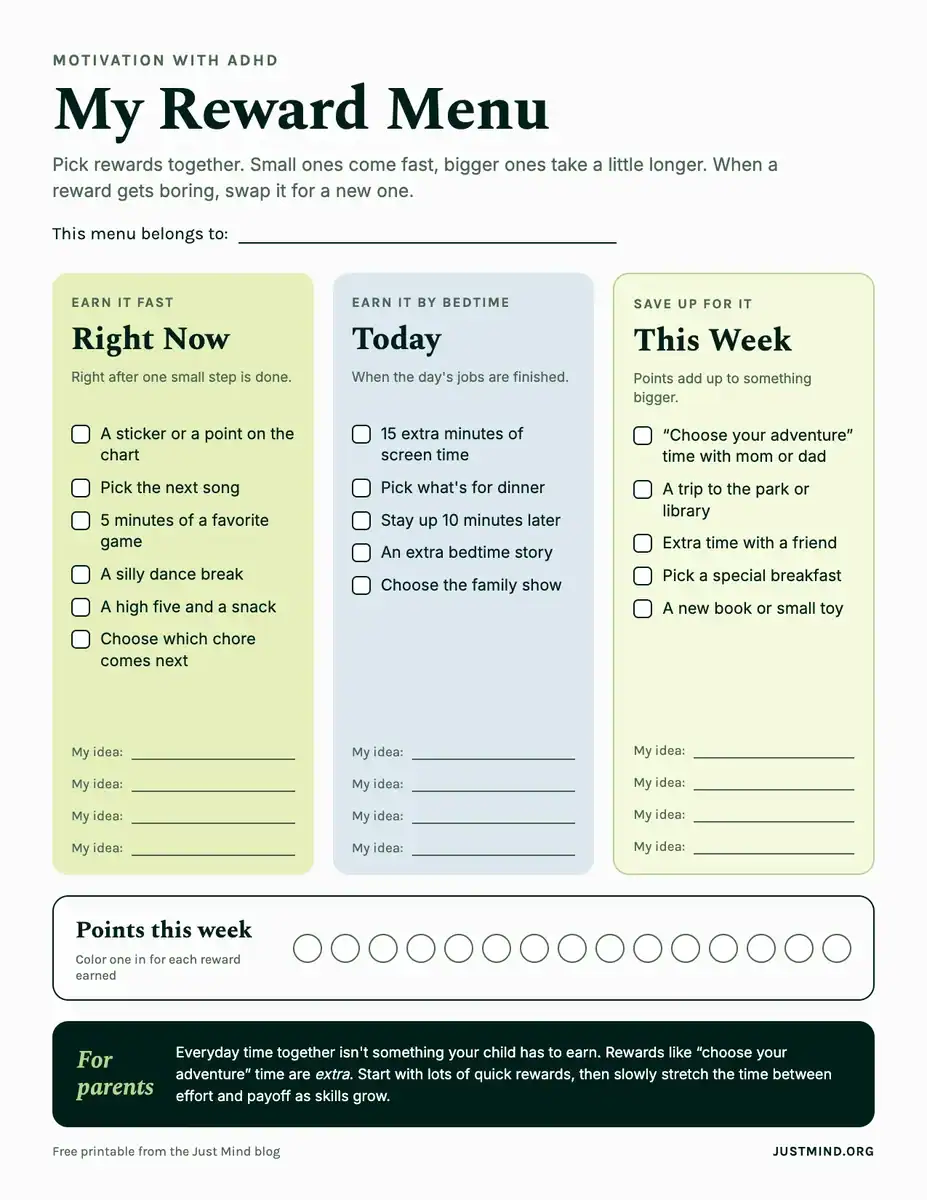
- Make the reward quick and frequent. A sticker chart that pays out on Friday is too far away for most kids with ADHD. Try small payoffs along the way, like a point for each worksheet or five minutes of a favorite game once the dishes are in the dishwasher. You can still work toward a bigger reward, but the small ones keep the engine running.
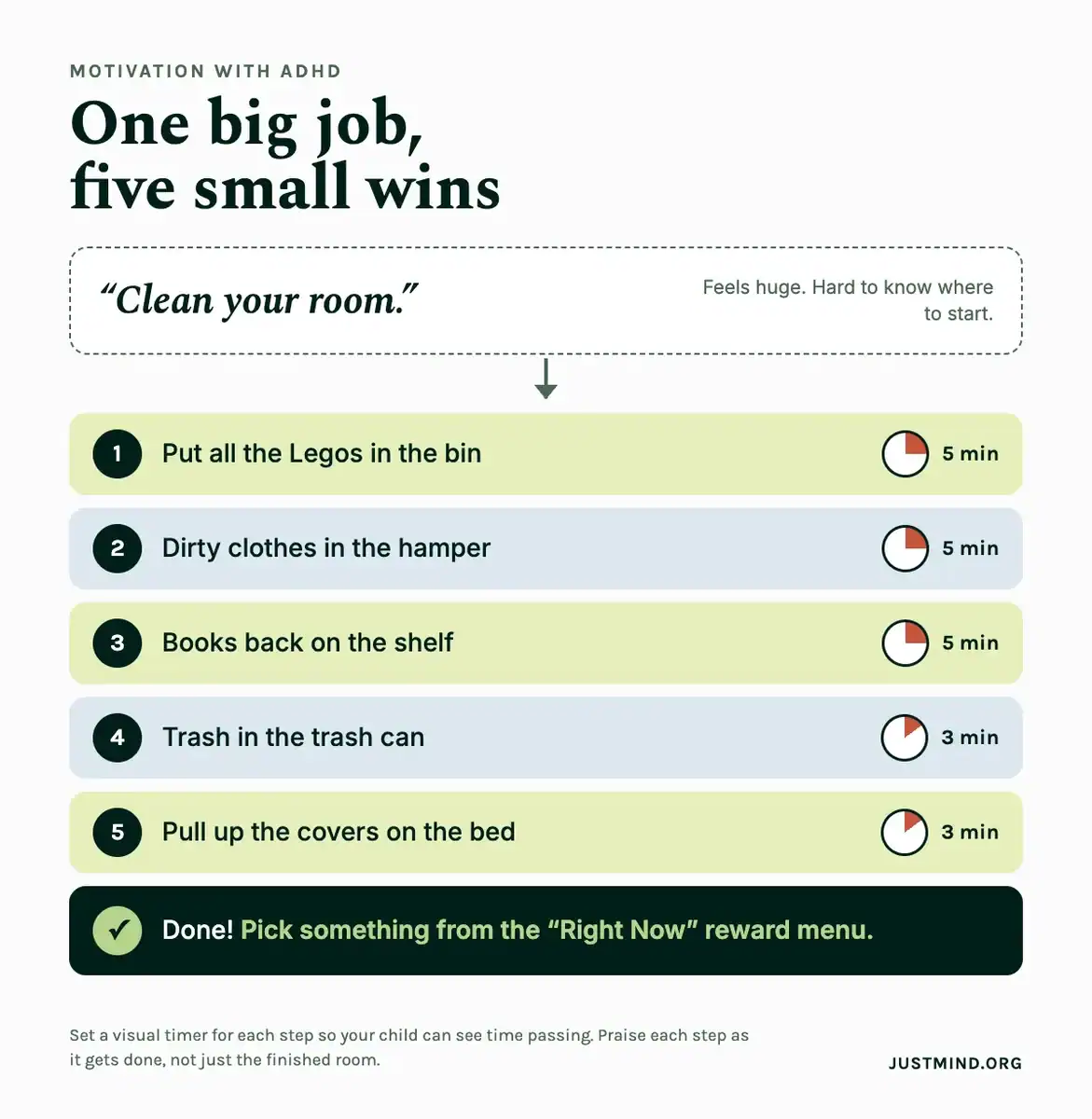
- Shrink the first step. Getting started is often the hardest part (it’s the Initiation skill in the list below). “Clean your room” feels huge. “Put all the Legos in the bin” is doable. Once your child gets moving, momentum often carries them further than you expected.
- Make time visible. Because of time blindness, “you have 20 minutes” doesn’t mean much to a child with ADHD. A visual timer, a playlist that lasts as long as the chore, or a race against the clock turns time into something they can see and even play with.
- Keep it new. A reward or routine that worked great for two weeks will often stop working. This is normal for the ADHD brain, which gets used to things quickly. Rotate rewards, let your child choose from a menu of options, or turn the task into a game (can you beat yesterday’s time?).
- Do it alongside them. Many kids with ADHD work better with someone nearby. Sitting at the table with your own work while they do homework, sometimes called body doubling, makes it much easier for them to start and to stick with it.
- Let them move. Standing at the counter, sitting on an exercise ball, or doing ten jumping jacks between math problems can help the brain stay alert enough to keep going.
Above all, keep the relationship warm. Motivation grows when kids feel capable and connected, so notice their effort out loud, even when the result isn’t perfect. If you’ve tried all of this and homework time still ends in tears, our ADHD counselors work with kids and parents on exactly this.
3 Things to Consider Before Choosing Rewards
Before choosing behaviors and rewards, here are three important caveats to consider:
- Make them doable, i.e., developmentally appropriate. If this is a behavior you’ve seen your child accomplish but has difficulty staying motivated, it is possible. However, be careful not to set your child up for failure by expecting them to have skills beyond their level of development, keeping in mind that executive function skills (listed below) for kids with ADHD may be as much as three years behind their neurotypical peers. Circumstances are critical, too. For instance, practicing Hot Chocolate Breath with you and making it fun when your child is feeling good is doable; asking them to do it when they have flipped their lid is probably not because they are not in their thinking brain. That is when you model using Hot Chocolate Breath yourself out loud and allow your child to “borrow” your calm nervous system.
- Catch them doing what you want or the opposite of what you don’t want. Imagine what their behavior would look like if they did not do the problem behavior. Then catch them doing that in any small way, in any situation. For example, if they always throw their clothes on the floor, the opposite would be picking up and putting things away. So when they put their plate in the sink or their school tablet in their backpack, praise them by stating what they did and thank them for being thoughtful about putting things away and how helpful that is for you.
Specific positive praise (what they did and why it is helpful or important to you) is much more powerful and effective at shaping new behavior than criticism and corrective statements. - Be sure that having special time with you or their friends is “extra.” Kids with ADHD need a bunch of loving and nurturing time with caregivers and social time with peers to feel connected and help to balance out the daily challenges of ADHD. So if they get a good dose of fun and loving time with you already, they might get an extra 15-20 minutes of “choose your adventure with mom or dad” time for a reward. Or if they already have playtime with friends, they might get “extra” time or an extra special event with friends for a reward.
How Rewards Increase Motivation With ADHD
Rewards help all kids, but they matter even more for kids with ADHD. It’s about dopamine and brain development. Dopamine is the brain chemical that says “this is worth doing,” and the ADHD brain doesn’t get as much of that signal from ordinary tasks like homework or chores. A reward adds the missing spark, so the task finally feels worth starting.
Timing matters, too. The skills that help kids wait for a payoff, plan ahead, and stick with something boring develop more slowly in kids with ADHD (remember, executive function skills can run up to three years behind). That’s why a reward that comes right away works so much better than one that comes at the end of the month. As those skills grow, you can slowly stretch the time between the effort and the reward.
Parents sometimes worry that rewards are just bribes. The difference is timing. A bribe gets offered in the middle of a meltdown to make it stop. A reward is agreed on ahead of time for a specific behavior you want to see more of.
Want to try this at home? Sit down with your child and fill in a reward menu together. Letting them help choose the rewards makes them much more likely to work for them. Download our free printable reward menu (PDF).
Executive Function Skills
This list of Executive Function Skills is based on an article by Drs. Gerard A. Gioia, Peter K. Isquith, Steven C. Guy, and Lauren Kenworthy and the National Center for Learning Disabilities (2005).
1. Inhibition: The ability to stop the behavior at the appropriate time, including blocking actions and thoughts. This includes the ability to slow down our physical and verbal activity levels. The flip side of inhibition is impulsivity, a weak ability to stop yourself from acting on your impulses.
2. Shift: The ability to move freely from one situation to another and think flexibly to respond appropriately to the situation.
3. Emotional Control: The ability to modulate emotional responses by bringing rational thought to bear on feelings.
4. Initiation: The ability to begin a task or activity and to independently generate ideas, responses, or problem-solving strategies.
5. Working memory (Verbal and Non-Verbal): The capacity to hold information in mind to complete a task.
6. Planning/Organization: The ability to initiate and manage current and future-oriented tasks.
7. Organization of Materials: The ability to impose order on work, play, and storage spaces.
8. Self-Monitoring: The ability to monitor one’s performance and to measure it against what is needed or expected.
9. Task Completion and Persistence: The ability to persist when a task is challenging and tolerate/manage the reactivity to frustration.
10. Perception of Time: 5 minutes of tedious activity feels like FOREVER. This is referred to as Time Blindness.
11. Sustained Focus: Ability to focus on tasks that are not exciting, preferred and self-chosen. Resistance to distraction.
ADHD exists on a continuum. It is essential to determine which executive skills are problematic for each child and to what degree. It is also imperative to understand that executive functions are separate from intelligence and creativity. Many children with ADHD have above-average intelligence and creativity.
Further Reading on Rewards and ADHD
These ADDitude articles have more reward ideas and go deeper into the science:
- Rewards for Good Behavior: How to Motivate ADHD Kids
- Behavior Chart Rewards to Motivate Kids with ADHD
- Rewards vs. Risks in the ADHD Brain: Why Positivity Works
- How to Use Rewards and Consequences to Motivate Your Child
Photo by Ramin Talebi on Unsplash